Author: goodberrypress_admin

  • Giant Pelican

    Large Beast, Unaligned

    Armor Class 11

    Hit Points 26 (4d8 + 8)

    Speed 10 ft., fly 40 ft.


    STR   16

    Mod (+3) Save (+3)

    DEX   12

    Mod (+1) Save (+1)

    CON   14

    Mod (+2) Save (+2)

    INT    4

    Mod (-3) Save (-3)

    WIS   11

    Mod (+0) Save (+0)

    CHA   5

    Mod (-3) Save (-3)


    Skills Perception +2

    Senses Passive Perception 12

    Languages

    Challenge 1 (200 XP) PB +2

    Actions


    Beak. Melee Weapon Attack: +5, reach 5 ft. Hit: 7 (1d8 + 3) Piercing damage. If the target is a Medium or smaller creature, it has the Grappled condition (escape DC 13).

    Swallow. The pelican swallows a Medium or smaller target it is grappling. While swallowed, the target isn’t Grappled but has the Blinded and Restrained conditions, and it has Total Cover against attacks and other effects outside the pelican. The pelican can have up to two targets swallowed at a time, and it can’t use Beak while it has two swallowed targets. If the pelican dies, a swallowed creature is no longer Restrained and can escape from the corpse using 5 feet of movement, exiting with the Prone condition.

    Credit: Ivo Hoying

  • Goodberry Gazette #11: Melodic Missiles

    Goodberry Gazette #11: Melodic Missiles

    Kala Lurr: “So then he spun this music box, and all I saw was purple light for the next minute. It felt like my skin was burning!” Interview with the latest robbery victim, transcribed by Thimbleberry Thunkin, reporter.

    Melodic Missiles is the magic item in our upcoming Goodberry Adventure Zine, Servant of the Sea God. As it is described within its stat block, it is a small music box that shoots musical notes. Almost every feature of Melodic Missiles is explosive, from its musical notes to explode upon impact, to the box itself on a failed save after expending its last charge. There is a small level of danger to using this item, forcing the characters to turn it into a strategic tool rather than a “hit and end turn” type of weapon. 

    When I first pitched this item to Ivo, I used Doctor Strange in the Multiverse of Madness as inspiration. In the film, Strange battles a variant which casts musical notes through the air, causing discordant noises as it deals damage. Since the adventure is a nautical-themed one, we envision the actual music caused by Melodic Missiles to resemble something like Davy Jones’s theme in Pirates of the Caribbean

    Thinking up magic items for your adventure doesn’t necessarily have to force you to stick to a certain theme. Trying to make your items match the adventure’s theme, such as a nautical one, can limit your creativity. It doesn’t have to be a cutlass, or a spyglass, it just has to be interesting! 

    Originally, I wanted this item to be completely different. I first envisioned it as a “portable trebuchet” – something you could deploy onto the ground, and have it unfold and be ready for characters to use. Not a fully-sized trebuchet, mind you: one maybe ten feet tall. After a lot of brainstorming, Ivo and I decided that something like that would have to be saved for a higher-level adventure, since it would naturally deal a lot of damage. However, that led us down the road of what the deployment would look like. Something wind-up? That led us to the music box idea. 

    Magic items, at the end of the day, only have to be one thing: unique and fun to play with. Do that, and your players will never want to leave your table. 

    By Inti Navia

    Magic Item by Ivo Hoying

  • Goodberry Gazette #10: Old Raena

    Goodberry Gazette #10: Old Raena

    “She welcomed us with open arms. Gave us piping hot stew, a warm drink, and a generous discount on her nicer rooms in the inn. ‘Course, the first night we didn’t find the passages behind our walls, or see the peep holes cut into the painting. The second night, we didn’t hear the door creaking open.” Captain Breardon, dead. 

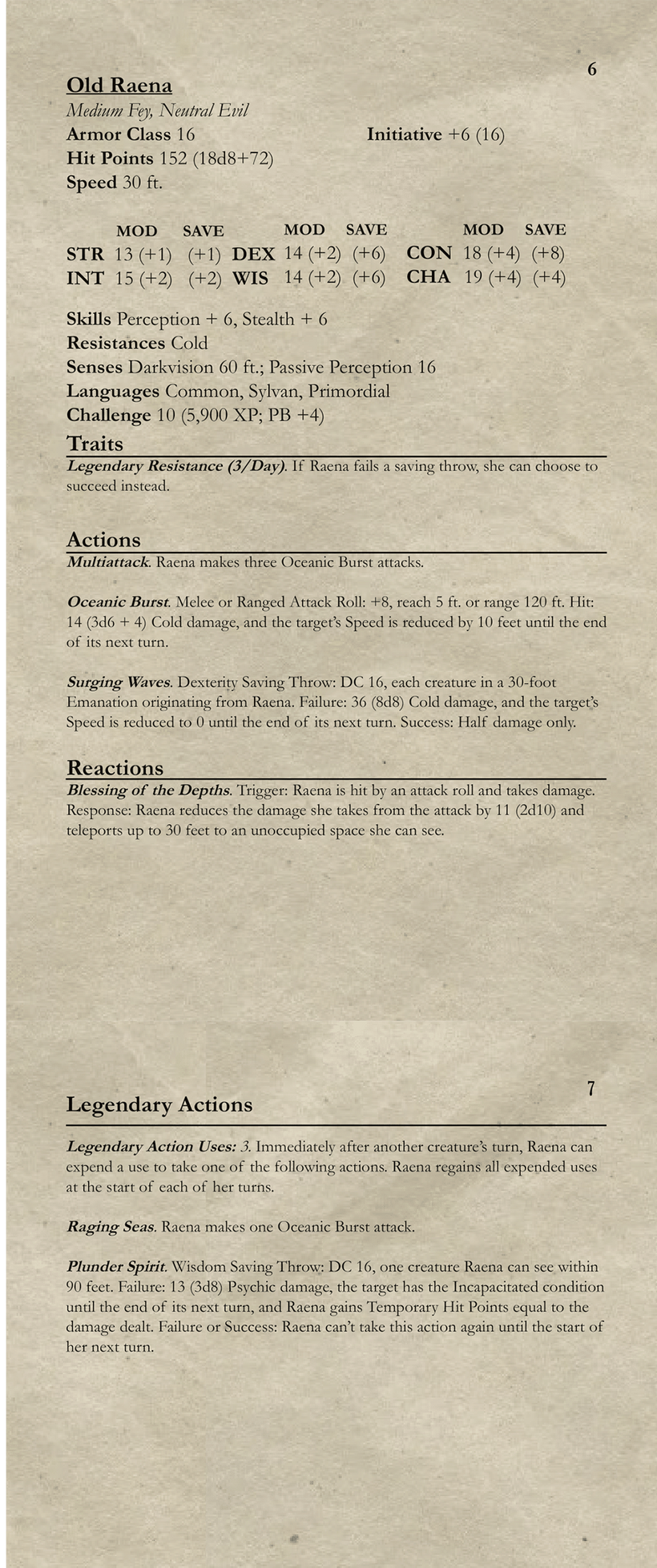
    Designing Old Raena was an interesting challenge, as it felt important to make sure she was sustainable while still upholding the archetype of a “squishy” magic user that can fold under pressure from powerful melee attackers. Rather than giving her a boatload of hitpoints, even though 152 is nothing to scoff at, a more interesting direction was to reinforce her survivability by making it difficult to pin her down. 

    This all begins with her Reaction Blessing of the Depths, which allows Raena to reduce the damage she takes from an attack that hits her and teleport 30 feet away. This gives her a much-needed response to aggressive martial characters, which can be nightmarish for monsters of her archetype. While it’s still best to keep her out of harm’s way, don’t worry if one of those pesky fighters or barbarians gets up in her grill, Raena always stays cool under pressure.

    Pairing with her teleportation are both of her main offensive tools, Oceanic Burst and Surging Waves. While both actions deal decent damage, 14 Cold damage for three hits and 36 Cold damage in a 30-foot Emanation, respectively, the utility of these abilities is what stands out. Any creature she hits with Oceanic Burst has its Speed reduced by 10 feet until the end of its next turn. And this stacks. This allows Raena to keep characters at bay, especially those she just teleported away from. Surging Waves does allow for a saving throw to reduce damage and avoid the secondary effect, but players better hope they save or they won’t just be slowed down. Any creature that fails its save not only takes sizable damage but has its speed reduced to 0, allowing Raena to freeze a whole group of characters attempting to gang up on her at close range. 

    Her Legendary Actions work to reinforce her playstyle further, with one option allowing for additional Oceanic Bursts, letting Raena slow down players at the end of their turn. But more interesting is Plunder Spirit, which does a little bit of Psychic damage but more importantly Incapacitates its target while also providing Raena with Temporary Hit Points. So while she jumps around the battlefield keeping her distance, the hag will continue siphoning energy from the players until they’re in perfect condition to be sacrificed. 

    Old Raena was a great statblock to write, and hopefully, you’ll have just as much fun tormenting your players with her. 

    By Ivo Hoying

    Epigraph by Inti Navia – intinavia.com

    This work includes material from the System Reference Document 5.2.1 (“SRD 5.2.1”) by Wizards of the Coast LLC, available at https://www.dndbeyond. com/srd. The SRD 5.2.1 is licensed under the Creative Commons Attribution 4.0 International License, available at https://creativecommons.org/ licenses/by/4.0/legalcode.

  • Goodberry Gazette #9: What’s All This For?

    Goodberry Gazette #9: What’s All This For?

    “Sehrabadd is really, really old. I mean, we’re always finding tombs and dungeons, and none of them belong to the same ancient civilization!” Tala, Wolfchanger. 

    Yesterday we released the first in our line of Goodberry Adventure Zines, titled The Encroaching Wood. Once a month to those subscribed to our “Adventurer” tier, we will release these exclusive zines, which contain TTRPG adventures with custom stat blocks and magic items. You may see us post these stat blocks for everyone to see, but the service we are providing is those stat blocks with a ready-to-go adventure for GMs to play at their table. 

    All of these zines take place within The Reach of Sehrabadd, a large peninsula with diverse terrain and people. From Maldavore Marsh, to the jungle of Korath, through The Wöisaen (Woe-shen) Steppes, down to the scorching Shattered Gulch. Ivo Hoying and I’s ultimate goal is to build an audience for this world so that we may one day release a world book for it, complete with a custom campaign inside. 

    How can I see this world book?

    Making a big world book is pricey. In order for us to release it to everyone, we made this Patreon for people to see what kind of TTRPG goods we offer, and the quality of our work. If you want to see our world book, the best way is through supporting us! Becoming an “Adventurer” will gain you access to our monthly zines, but if you want to forgo a subscription, we have tip options on our Patreon page, as well. A month after the zine release, we will make it available as a one-time payment on our page, too. 

    We’d love to chat! 

    From Thursday, July 31st to Sunday, August 3rd, Goodberry Press will be at GenCon! Find us at Aaron Miller’s booth, 1357, and stop by to talk! 

    More adventures await within The Reach of Sehrabadd…

    By Inti Navia

    intinavia.com

    GenCon Booth art by Aaron Miller – aaronbmiller.com

  • Goodberry Gazette #8: The Ideal Adventure

    Goodberry Gazette #8: The Ideal Adventure

    The Forbidden Island loomed before us, and we were left with a sense of awe and dread. What the pirates had hinted at before left a dark sense of foreboding over the tropical branches and white beaches. Why had our employer led us to this place?

    A strong hook will make the characters pursue the adventure the GM crafted for them. The strongest motivation that characters will follow is the promise of gold. Hint at a valuable treasure hidden in the troll cave, or a priceless amulet that the evil sorcerer possesses. Trying to make them go to the cave because it’s something for them to do isn’t going to be enough. They need a powerful reason to go there. Sometimes it works to have them go and rescue innocent civilians, or a lost pet, but the characters usually do it more out of a sense of “doing a chore” rather than because they really want to. 

    The traditional five room dungeon is a great example of a fun adventure. Let’s assume there’s a bit of a journey to get to the troll cave/dungeon. The GM has a chance to throw a random encounter the characters way, to give them a taste of combat before they get into the meat of it. Random encounters never have to be complicated, because they’re inherently short and sweet fights that don’t need complicated stat blocks. Pull out some goblins or maybe a custom stat block of your own. 

    The first room is the entrance, in which the characters have to find a way to gain access to the dungeon proper. This can be through a puzzle, a riddle, or perhaps even just a clue that an NPC told the characters along the way. The second room is the guardian– the fearsome protector of the dungeon. It’s great to have fun with this one. It doesn’t necessarily have to be combat focused. For example, this guardian could ask the characters a riddle. If you do go the combat route, make the fight engaging. Take advantage of the terrain around the room. Give the characters options instead of straight swords and staffs and spells. The third room is the puzzle room. It’s always better to lean on the easier side than the harder side for puzzles. The last thing you want is your characters stuck on one puzzle for hours. It just makes everyone annoyed and takes the fun out of the game. For the fourth room, the boss room, pull out all the stops for this one! Go crazy on the stat block. This has been what the adventure has been building towards, so anticipations are high. Utilize those engaging environments. Give it cool dialogue. So when you arrive in the fifth room, the treasure room, the characters feel truly rewarded. 

    If you’re designing a longer campaign, feel free to leave a plot thread in the boss chamber. Have him allude to “the greater threat” or just as the characters finish him off, have the BBEG swoop in to deal the killing blow for being an “unfaithful servant”.  It doesn’t have to be complicated. The characters should be left with enough juice to want to keep playing the adventure. 

    It’s important to remember that the five room dungeon is just a guideline, it’s not a rule. I didn’t invent the idea of the five room dungeon, and rarely do I use a physical dungeon, but I use its concepts all the time. You don’t have to send your players to a dungeon at all. It can be a gnoll encampment. It can be a dark forest. What matters is the process of what they do once they’re inside. A mix up of all those elements leads to a diverse and fun adventure for everyone. 

    By Inti Navia

    intinavia.com

  • Goodberry Gazette #7: How Do You Make An Interesting Stat Block?

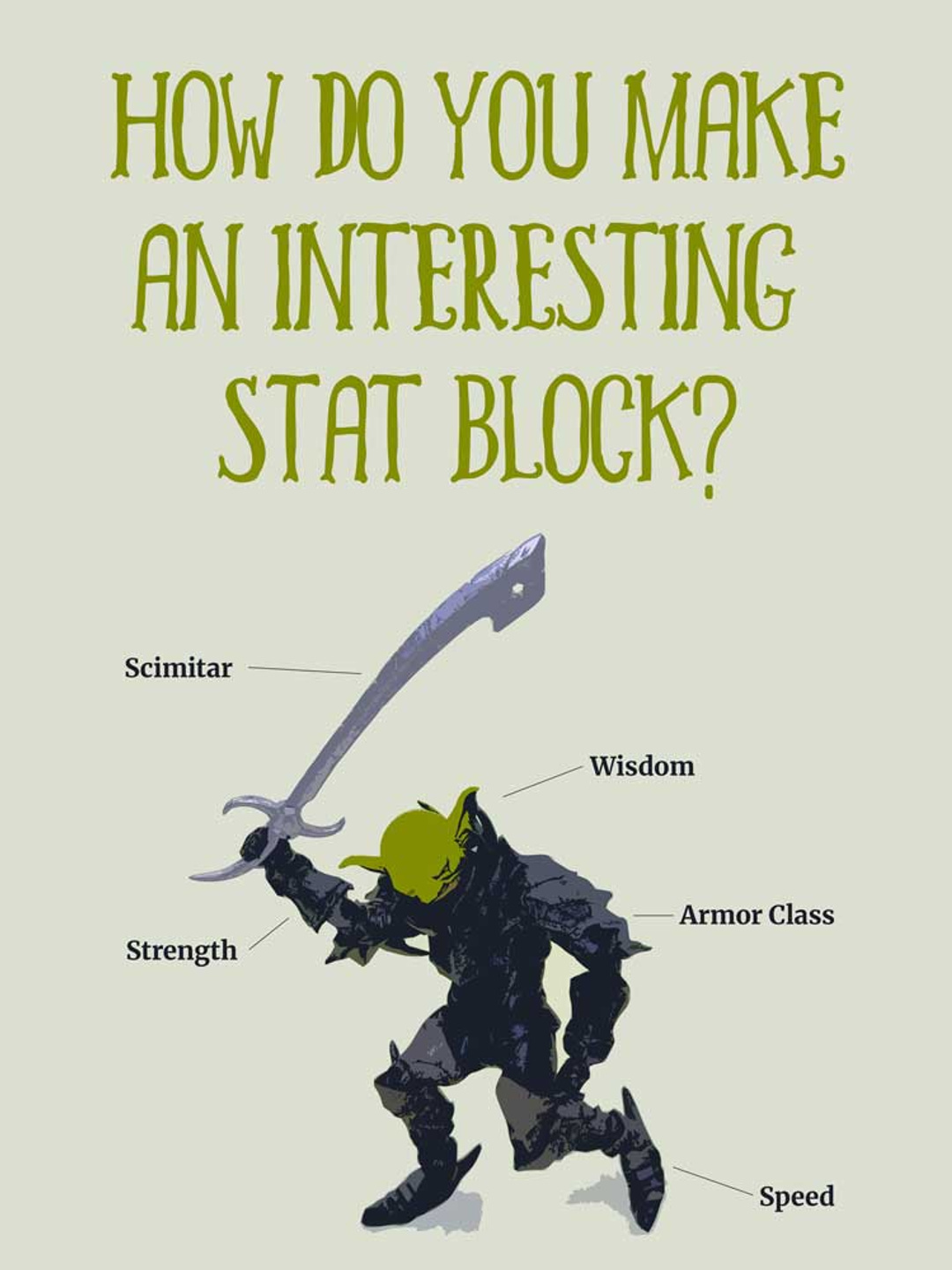
    Goodberry Gazette #7: How Do You Make An Interesting Stat Block?

    “Give me an army of goblins over a Sehrabaddian dragon any day. A death by the first option is painful, yes, but you really don’t want the alternative.” Malafin, ranger.

    The key to making an interesting stat block is to assign your creature attributes which follow its design. Assigning random damage immunities, actions, and reactions just for the sake of making a hard enemy to beat doesn’t make sense. Put a little work into the enemy that could TPK!

     I’m kidding. Don’t TPK. 

    Let’s use the goblin as an example. Maybe it’s part of a goblin tribe that lives in the heart of a volcano. It could have a resistance to fire damage, since its species has become acclimated to living there. That way, if you set a fight with it next to a pool of lava, the party can’t easily dispose of it by chucking it in. Go for the fire damage immunity, too, if you think it’s necessary. It’s all about crafting a well-balanced encounter that’s not too easy, but won’t kill everyone. 

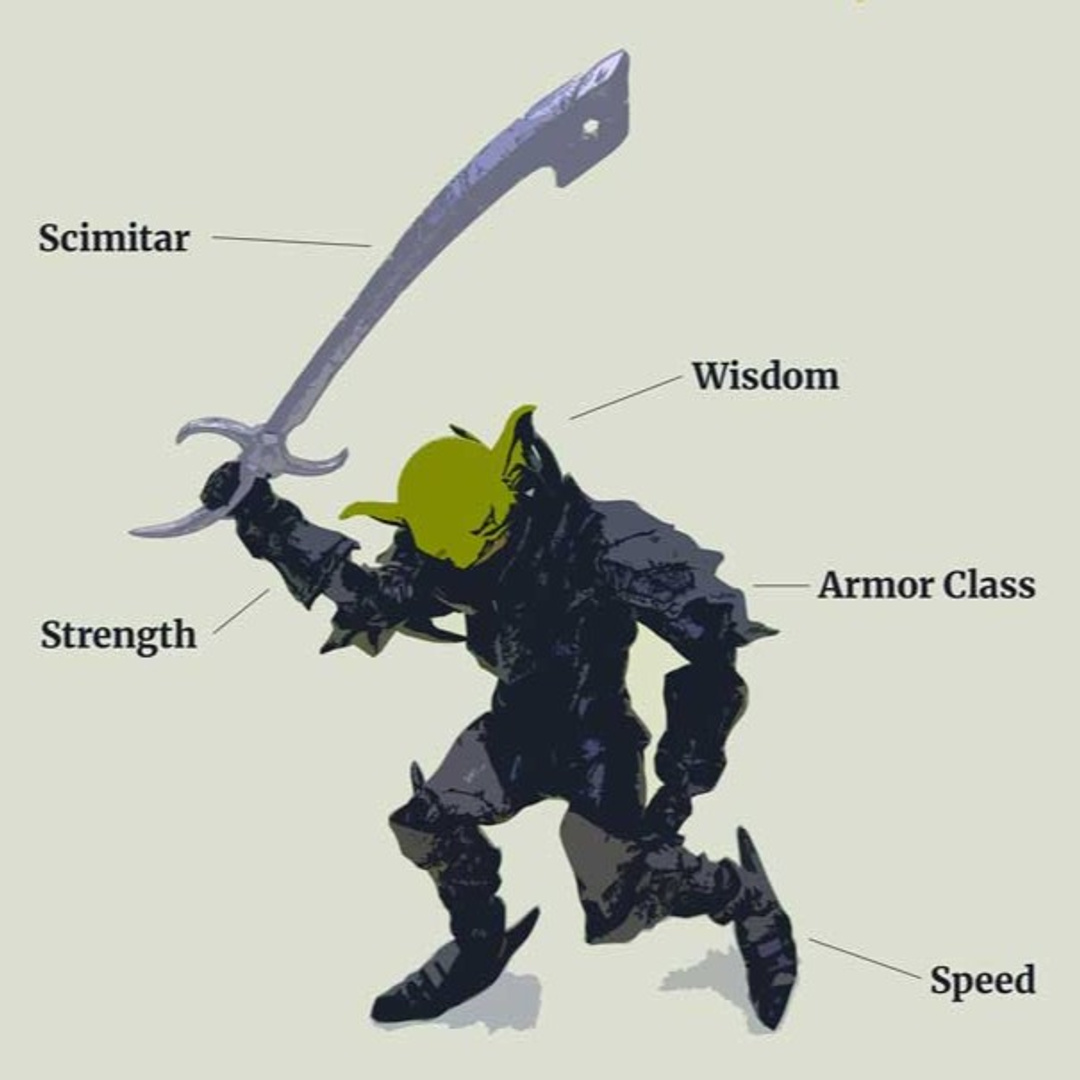
    A simple spear or claw attack is a little boring for this goblin, too. What about it is unique enough that you can utilize as an attack? Maybe it has access to a fireball spell, or maybe it has an ability called Simmering Skin, where any creature that comes in contact with its skin takes fire damage. Then you can give the goblin a charge action, where it’ll try to ram itself into a character, so they take damage from Simmering Skin. 

    It’s a little goofy. You can lean into the more absurd side of monsters, or aim for the classic low-level realism. Either way works, because it’s a TTRPG, which is an inherently goofy genre. 

    This can be applied to any part of the stat block. At the end of the day, what’s most important is that the fight fits that sweet spot, of not too difficult, but not too easy. Scale it based on its placement, too. Is it the final boss? A quick encounter? Keeping this in mind, you’ll be able to easily craft a fun encounter for everyone at your table. 

    By Inti Navia

    intinavia.com

  • Goodberry Gazette #6: Rewarding Your Party

    Goodberry Gazette #6: Rewarding Your Party

    The Anukharan tomb glittered with the wealth of a dead kingdom. Gold spilled across the room, accompanied by jewels, stones, necklaces, swords, and apples made of diamond. Cade collapsed to the ground. After all they had gone through; trials and tribulations, monsters and magic… they had reached the legendary lost treasure vault. 

    After an encounter-packed adventure, the characters will be expecting something to reward them for their efforts. Without a proper reward, the players will quickly lose interest, and lose a sense of accomplishment. It can be tempting to write the encounter with the goblin and have it be over and done with, but adding a chest of loot that the goblin collected is the critical cherry on top for the adventure. 

    Don’t overinflate the valuables of the world, either. If you’re on session one of a campaign, give them a taste of what’s to come. Ten gold pieces. A valuable necklace. Don’t dump money on the players, because that erases the worth of all the treasure yet to come, since the GM would inevitably have to either keep making bigger payouts or the treasure to come is less so than the one the characters just got. 

    5e has a copper to platinum monetary system, but anyone who’s played a game in their life knows that everyone uses gold. Keep in mind that gold is still valuable, though. Don’t let it completely replace silver in terms of worth. The big treasure hordes of gold traditionally come at the end of the campaign, or sometimes after grueling boss fights. 

    Let yourself get more creative than just gold. Spice up the treasure chest with amethysts worth a certain amount of gold. Ancient artifacts. Precious jewels. They all mean pretty much the same thing (lots of gold!) but differentiating the treasure makes it feel special and unique. 

    Magic items are a great way to shake up the reward system, too. 5e and other TTRPGS have a lot of magic items in their books that GMs can easily draw from, but it’s  pretty easy to make one yourself. Just think of a traditional weapon or piece of armor in the game and give it a “superpower”. Swords can’t fly. Well, now this one can! Helmets can’t let the wearer see in the dark. Now it can! Your items don’t have to be complicated. Your players will appreciate anything you give them. 

    As we make our Goodberry Adventure Zines, one thing Ivo Hoying and I have been trying to keep in mind is where we give the magic items. Giving them at the end of the adventure is an option, if it’s really short, but it also doesn’t let the characters use the item in the fights. Try to find a way to reward your players with an item early on, so they can use the piece of treasure they’ve been given. 

    Remember, the real treasure wasn’t the friendships we made along the way. The real treasure was the treasure. 

    By Inti Navia

    intinavia.com

  • Goodberry Gazette #5: Making An Adventure

    Goodberry Gazette #5: Making An Adventure

    “A good adventure means a menagerie of monsters, a rewarding quest, and ideally coming home alive.” Malafin, ranger. 

    Creating a TTRPG adventure is, at the same time, both easier and more difficult than it sounds. It’s one thing to have a good idea for a story, but another to make it able to fit the genre that it’s in. 5e is unfortunately not a very narrative-driven game. The GM could have an idea of where they want the story to go, but at the end of the day, the players are going to decide what they want to do. That’s why when you’re creating a game, you have to always keep that in mind as you build it. 

    Rather than railroad players, make an environment where the decisions they make will align with how you want the story to progress. In our upcoming Goodberry Adventure Zine, The Encroaching Wood, the setting of a magical forest spreading from ancient ruins is the center of the story. That’s why the characters are in the area, and that’s the clear thing there is to do. It’s not a broad world in which they arrive in town and the NPCs keep mentioning an encroaching wood (A.K.A the GM desperately trying to get the players on track), and the characters aren’t being forced into it, either. 

    They arrived in town because they heard rumors of the wood, and the baron can reward them if they go and stop it. The goal is for the characters to play your game not because they feel like it’s what the GM would want, but rather because they actually want to play it. 

    Another key to making an adventure is combat. The combat needs to be exciting. It’s one thing to put a guy who does a lot of damage in an empty room, but another to make that fight engaging. If the description mentions the environment, and what kind of natural terrain and potential weaponry the characters can utilize, then one of them will probably use it, and have more fun fighting the BBEG. 

    The villain’s job isn’t necessarily to hit hard, either. Take into account its range, vulnerabilities, and unique attacks. There’s a million bite attacks out there, so it doesn’t hurt to go one step further and give the villain a unique trait that enables it to have a more interesting way of dealing damage. 

    The key to writing a TTRPG adventure is primarily an engaging setting, and engaging combat. All you need is one idea to blend those two attributes into an awesome encounter for everyone at the table. 

    By Inti Navia

    intinavia.com

  • Goodberry Gazette #4: Creating a World

    Goodberry Gazette #4: Creating a World

    “Aye, been livin’ all my life in the Wöisaen Steppes, I have. Nice enough place, I s’pose. Just don’t go into those ruins at night.” Orda, Wöisaen farmer. 

    The Wöisaen Steppes (pronounced woe-shen) is the setting of our upcoming Goodberry Adventure Zine, The Encroaching Wood. It’s a large region within the wider Reach of Sehrabadd, with the terrain primarily looking like, well, a steppe. Dark green grass, rolling hills, and whipping wind. 

    When Ivo Hoying and I sat down to figure out where we wanted our adventure to take place, we picked our relatively under-developed area of the map. Keep in mind, when I say “under-developed”, I don’t mean in terms of infrastructure or anything literal. I mean the idea for the region was under-developed. We knew we had a large grassland area taking up a big chunk of Sehrabadd, but we didn’t know what was in there. 

    The name, Wöisaen Steppes, obviously draws inspiration from the real world. Not just from the Mongolian Steppe, but from Irish culture, as well. I remember looking at pictures of the Irish countryside, and thinking “Huh. Some parts of this country look a little like Mongolia.” Then we proceeded to combine the two. 

    Setting The Encroaching Wood in The Wöisaen Steppes forced us to think more about the place. Are there cities? Who’s hiring your party? Some kind of ruler? What do the locals think of this emerging threat? 

    You don’t always think about things like that when you’re making a fantasy world. You paint the broad strokes and think it’s the finer details, until the time comes in your writing where you have to think about the finer details, and you draw a blank. 

    Try to keep that in mind when you make things like this, but also put yourself in a situation where it’s forced out of you. It’s cool to have areas of your world for the sake of having them, but it’s way cooler if your story takes place on that forbidden island full of dragons, rather than the capital kingdom of such and such. The Wöisaen Steppes feel alive, now, rather than just a name on a map, and that’s what a TTRPG world, or any kind of medium, demands. If there’s one section totally developed, and the rest just references, then it feels like a dead world. 

    Keep an eye out for The Encroaching Wood, dropping on Goodberry Press’s Patreon for those subscribed to the “adventurer” tier. 

    By Inti Navia

  • Goodberry Gazette #3: Origins of the Wood

    Goodberry Gazette #3: Origins of the Wood

    The Walcoth Abbey was the center of religious significance for the Aisling Fief, and known further beyond throughout the Wöisaen Steppes. One day, a monk angered their patron god Veridos, and he made known the full fury of his forest. Now only wood and vines pray inside the abbey’s crumbling walls. Author unknown. Writings discovered by “Doc”, adventurous tinkerer. 

    Our upcoming Goodberry Adventure Zine covers the premise of an ever-expanding forest spreading from the ruins of a long-abandoned abbey. When we sat down to write these zines, we didn’t completely start from scratch. There was an older inspiration!

    Ivo Hoying, a member of our Goodberry team, had dozens of old adventures he had written for fun. When we decided to start creating monthly one-shots, we started with converting his old adventure into one we could use for the zine. Titled The Encroaching Wood, it’s very similar to how it was when it was originally written. What we did was swap out the names of characters and places to match our setting, tinkered with the stat blocks to update them to the newest version of 5e, and cut out some of the “fluff”. 

    When cutting it’s important to find a middle ground: cut too much, and it looks bad, is confusing to the GM, and takes away from the experience of the adventure. Cut too little, and the zine becomes very, very long without needing to be, the content on pages bleed over confusingly, and descriptions go on needlessly for a long time. It took some days of editing and cutting and adding to find that perfect sweet spot, but after enough trial and error, we did find it. 

    Sometimes you don’t need to reinvent the wheel when it comes to creating campaign (or in this case, one-shot) settings. If you’ve been playing the game a while, chances are you have some idea buried in your computer or in a scratched up notebook in the back of your closet. Take a look through that. Even if the language needs work, the idea will be there, and you can use that as the foundation for a great story. Even if you haven’t written anything for a TTRPG, take a look through that old journal of yours, or your sticky notes, or anything you use to jot down whatever’s in your head. More often than not, than can jumpstart an idea for an adventure faster than trying to come up with a brand new one. 

    We avoided writing around artwork. Rather than basing an adventure off of artwork we knew we one hundred percent had access to, we decided to create what we wanted to create, and worry about the accompanying art later. Trying to limit yourself based on your perceived ideas of what you do or don’t have access to can quickly suffocate your work, bleeding the creative juices out of it. 

    Our upcoming Goodberry Adventure Zine, The Encroaching Wood, is the result of our team’s dedicated effort to provide you with something special to play around the table. See you soon.